Can You Throw Weapons in Quasimorph?
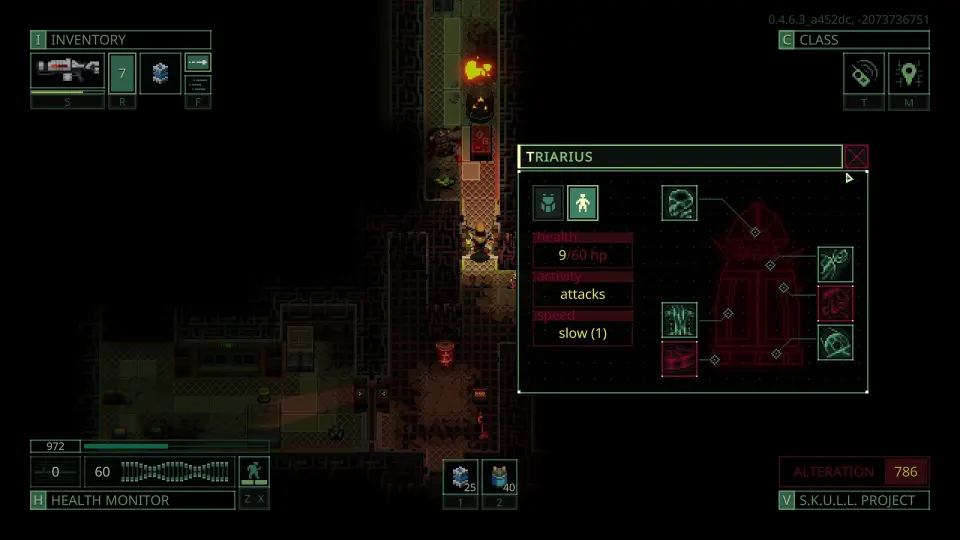
If you are searching for a quick way to throw a gun or melee weapon at an enemy, do not spend a dangerous turn hunting for a hidden shortcut. Quasimorph’s combat advice centers on equipped weapons, ammunition damage types, manual aiming, and movement actions—not a standard weapon-throw action. That matters because trying an unsupported action while exposed can leave your clone unable to fire, move, or safely open a door.
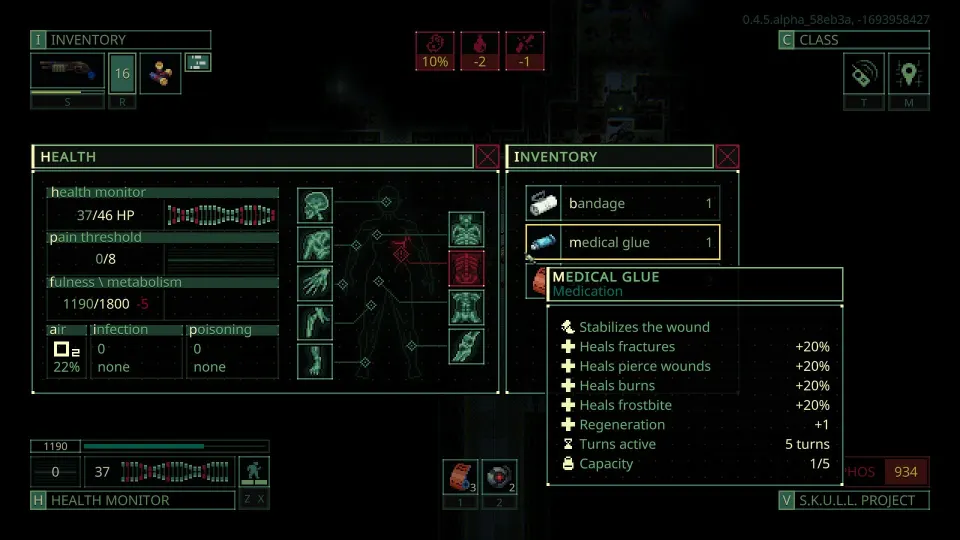
Weapons are primarily tools to equip, fire, reload, swap, and dismantle. If an item menu or current version presents a contextual throw option, treat it as a special item interaction and confirm its action cost before relying on it. Do not assume every weapon can be thrown simply because it is in your inventory.
For players asking quasimorph how to throw weapons, the practical answer is to first inspect the selected item’s available actions. If no throw command appears, switch to an equipped weapon or use the item for its intended purpose instead. A reliable ranged attack is usually more valuable than losing an equipped weapon to an uncertain throw.
| Situation | Best response | Why it is safer |
|---|---|---|
| A weapon is in your backpack | Check its item actions before committing | Inventory items do not automatically become throwable attacks |
| An enemy is around a corner | Use manual targeting with an equipped firearm | It can create a viable firing line without discarding gear |
| You need a different damage type | Swap weapons or ammunition | Enemy resistance can make the current attack ineffective |
| You are out of ammunition | Retreat, reposition, or use another equipped weapon | Preserves equipment and avoids a wasted action |
| A hazardous container blocks the way | Interact with it and remove fuel or poison | Prevents explosions or poison hazards during combat |
A thrown weapon, even if an interaction is available in your build, should not replace loadout planning. Carrying two damage types gives you answers to different enemy resistances, while a third weapon slot from a servo backpack can widen those options further.
Check the Action Economy Before You Act
Quasimorph is turn-based, so every interaction has a cost. The real danger is not merely failing to throw a weapon; it is ending your turn where an enemy has a clear line of fire. Before testing any unfamiliar item action, count your remaining actions and make sure you have cover, distance, or a closed door between your clone and hostile targets.
Movement mode changes how much flexibility you have. Stealth movement provides one action and helps you sense nearby enemies. Normal movement gives two actions, making it the most dependable combat mode for opening a door and still shooting or moving away. Running provides three actions, but it reduces accuracy and prevents certain interactions.
| Movement mode | Actions per turn | Main advantage | Important limitation |
|---|---|---|---|
| Stealth | 1 | Helps detect nearby enemies and uses fewer calories | Opening a door can immediately end your safe turn |
| Normal | 2 | Supports move-and-shoot or open-and-shoot decisions | Slower than running |
| Run | 3 | Fast escape and repositioning | Accuracy penalty; cannot perform many interactions |
| Manual targeting | Depends on weapon action | Lets you aim along a chosen line | Scatter and accuracy can still alter the result |
A good default is to explore cautiously in stealth, then change to normal movement before opening doors or engaging enemies. Use running when the priority is escaping, not when you expect to manage inventory, loot, wounds, or environmental objects.
Follow this sequence when an enemy appears:
- Stop before spending your final action.
- Inspect the enemy’s resistances when possible.
- Choose the weapon and ammunition damage type that best fits the target.
- Use normal movement if you need both positioning and an attack.
- Hold Shift to manually aim when the automatic target line is blocked or unhelpful.
- Keep one action available whenever opening a door could expose you.
- Reassess after every shot instead of assuming the enemy is down.
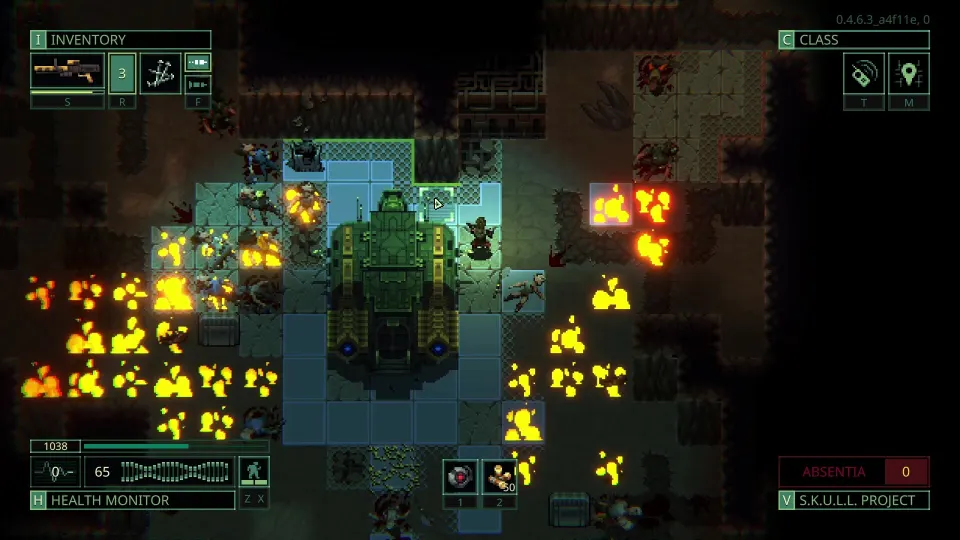
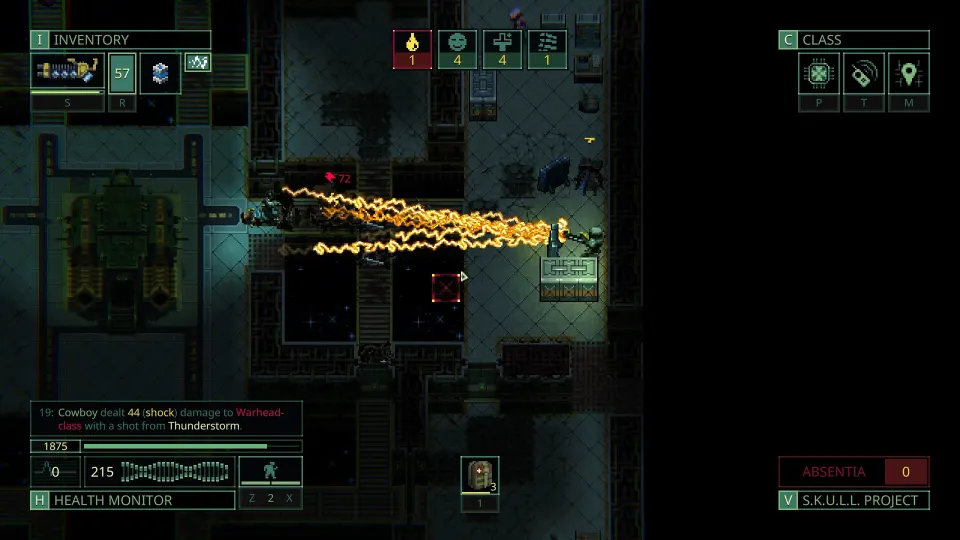
Manual targeting is especially useful when an enemy is near a corner. The usual target display may indicate that a wall blocks the shot, yet aiming at a neighboring tile behind or beside the enemy can produce a line that lets weapon scatter reach the target. This is not guaranteed, but it is a more dependable tactical experiment than throwing away a firearm.
Use Weapons for Damage Types, Not Improvised Disposal
The strongest reason to keep weapons equipped is that Quasimorph enemies have different resistances. Ammunition can deal damage such as fire, cut, piercing, or beam, and a target’s resistance reduces damage from that type. A weapon that looks powerful can perform poorly if its ammunition matches the enemy’s strongest resistance.
Bring at least two ways to deal damage whenever your available inventory allows it. A shotgun and an alternative firearm or ammunition type can cover more situations than several copies of one weapon. This becomes increasingly important when facing armored humanoids, cyborgs, and Quasimorphs with distinct defensive profiles.
| Combat problem | Better weapon decision | Tactical result |
|---|---|---|
| High fire resistance | Change away from fire damage | Avoids reduced damage from a poor matchup |
| Low cut resistance | Use a cut-focused option, such as suitable buckshot | Exploits a vulnerable damage type |
| Long corridor | Manually aim downrange | Can reach targets or hazardous objects outside normal targeting convenience |
| Enemy near a corner | Aim at an adjacent tile with Shift held | May create a workable shot angle |
| Several enemy types on one contract | Carry multiple damage types | Reduces the chance that every shot is inefficient |
Weapon handling also affects your inventory. A servo backpack can provide an additional weapon slot and reduce reload duration for the weapon in that slot by one turn. It does not function as a normal nested storage container, but it can make a three-weapon setup workable. After combat, switching back to a larger backpack can improve looting capacity without abandoning useful gear.
Use quick transfers carefully as well. Control-clicking an item can move it between containers when there is space, and may prioritize equipping armor or weapons when appropriate. That speed is helpful after clearing a room, but do not let fast looting replace threat checks. Hold Alt to highlight visible enemies in red and corpses in white, especially after fires or explosions obscure the floor.
FAQ
How do I throw weapons in Quasimorph?
For quasimorph how to throw weapons, first select the item and check whether its current interface offers a throw action. There is no broadly established standard weapon-throw workflow to depend on in normal combat guidance. If the item has no throw command, equip a weapon and attack normally, or use another available item action.
Should I throw a weapon when I run out of ammo?
Usually no. Swap to a second weapon, change ammunition, retreat, or use a weapon better suited to the enemy’s resistance. Losing an equipped weapon can leave you weaker for the rest of the contract.
What should I do when automatic targeting says a wall blocks my shot?
Hold Shift for manual targeting and try aiming at a tile beyond, beside, or behind the enemy. Weapon scatter and accuracy still matter, but this can find lines that the standard target selection does not make obvious.
Why should I avoid opening doors on my last action?
Opening a door consumes an action. If it ends your turn, enemies on the other side can act while you are exposed. Open doors with at least one action remaining whenever possible, so you can shoot, move, or reassess immediately.